Dear friends,
The weather this past week has been warm (in the low to mid 80s), with our usual late afternoon breezes and occasional puffy clouds. Draven and I finished mowing and pulling the most invasive weeds from the south field last week and have just a little bit of cleanup left to do.
What weeds, you may ask? Teasel, tansy ragwort, common tansy, bull thistle, Canada thistle, blackberry, redroot pigweed, and Queen Anne’s lace are the main targets. We’ve just been chipping away at this task, spending roughly two hours a day on it, four days a week for the past two months. We went after the tansies and thistles first, as they go to seed earliest. We still have a pretty heavy infestation of pigweed in the lowest part of the field, but made good strides toward containment this year.
Containment and control is the name of the game with invasive weeds—especially with perennial weeds like Canada thistle and blackberry that regrow from the root. Every time you disturb the soil by plowing or cultivating, you bring up weed seeds that have lain dormant in the soil for years. So “weeding” is actually a years-long process to contain and control the things you don’t want and promote and encourage the things you do way. (There might be some metaphors for life in that statement.)
On Saturday, Kim and I went on what we call a “drivey-drive”. We usually try to drive on some roads that we’ve never been on before or that we haven’t seen in this particular season. (Neither of us drive that much at all, and Kim’s car is an all-electric Nissan Leaf that mostly gets charged from our solar panels at the house in town during the week, so we allow ourselves the occasional purely recreational drive as not-very-guilty pleasure.) This time, we drove southwest from the farm through the Coast Range foothills to the upper reach of the Marys River, then more or less followed the Marys River through Blodgett and on down to Wren, and finally came back north to the farm via Kings Valley Highway (OR-223).

About half of the drive was on gravel roads. Except for the mile or so just west of Blodgett, the road never had more than two lanes—largely, the kind of drive my dad loved to promote in Travelin’ Magazine in the late 90s and early 00s.
Gage Road starts near Womer Cemetery in Pedee in the watershed for Ritner Creek and runs over the ridge into the watershed for the Luckiamute River. There are a few houses near each end, but otherwise it is nothing but timberland. It ends at Wildwood Road, where there is a one-lane bridge across the Luckiamute River, a few homes, and the former Wildwood Schoolhouse. This is the upper reach of inhabited land on the Luckiamute.
If you continue upstream on Wildwood Road, you will eventually arrive at the townsite of the Valsetz (one of Oregon’s last company towns). The road follows along the long-abandoned right-of-way for the Valley and Siletz Railroad, going near the headwaters for the Luckiamute River and then winding its way over the ridge into the valley where Valsetz was. It’s probably been twenty years since we’ve driven the Wildwood route to Valsetz; maybe that will have to be target for a “drivey-drive” where we have all day and a full tank of diesel in the truck.
We turned our wheels to the right, though, crossed the bridge and headed downstream on the Luckiamute and back onto pavement for a few miles. Our route took us past an old farm that is on the opposite bank of the river from the road. In the summer, the residents get across using a ford; you can see their driveway go down into the river and back up and out again. In the winter, they get back and forth using a suspension footbridge.
Just past Fort Hoskins Historic Park, we turned onto Hoskins-Summit Road, crossed the Luckiamute one last time, and headed west back into the woods. We have driven this gravel road a couple of times before, so after a few miles we turned onto Shingle Creek Road and bumped our way through the woods to the upper reach of the Marys River. There were a couple of miles of one-lane gravel road, but it was always interspersed with hints of civilization: an old fenceline, a power pole—even signs for buried fiber optic cable. Eventually, the road widened out a little and the air was filled with the smell of freshly cut douglas-fir as we came through an active logging operation (a nicely run thinning operation).
Then there was a nice little farmstead, and another… and we were in the Marys River valley. From the looks of things, this valley used to be home to dozens of small dairy operations, but now most of the pastures are getting overgrown; although there are still a few folks running a few head of beef cattle, the small dairies are long gone, as is the case in so much of rural America.
We explored the upper end of the valley, then turned around and headed back downstream to Summit and pavement. Summit is part art colony, part back-to-the-land community at the summit of the old route over to Newport—bypassed long ago by U.S. Highway 20. A former stage stop and inn is now a luthier’s shop. The Grange Hall and former church are beautifully maintained community spaces now. A train still comes through once a week or so, carrying freight to and from the paper mill in Toledo.
From Summit, we followed the railroad down to Blodgett. We’ve driven this route several times, and always enjoy how it winds through the woods and follows the railroad. (If you’re ever driving to Newport in an electric car, are trying to optimize your battery, and aren’t in a hurry, take the pre-U.S. 20 route on OR-180 through Summit, Nashville, Eddyville, and Chitwood. The road was designed for the lower-powered vehicles of the 1920s and 30s, so the grades are easier, making it ideal for electric cars. It’s a beautiful, fun route to take.)
Blodgett was heavily rearranged when U.S. 20 was widened, so it lacks the charm of Summit, but the Blodgett Country Store (and post office!) has hung on since 1888. We petted the store cat, admired the selection of goods, enjoyed the self-proclaimed “oldest walk-in cooler in Oregon”, and happily purchased a couple of ice cream novelties for the road.
We continued following the Marys River (more or less) and the railroad out of Blodgett along Harris Road, which eventually dropped us into a picturesque valley of small farms. The centerpiece of the valley is the Harris covered bridge and the neighboring vineyard and winery, which we want to go back and visit after the pandemic. The bridge is in great shape and still in use.
A couple of miles later, we were in Wren, where we headed north for home. We ended our drivey-drive refreshed and inspired—just as we had hoped. Between the pandemic, Kim’s crash in January, and our aging mothers, 2020 has been a challenging year for us, so little bits of self-indulgence like this make quite a difference for our mental health.
It turned out that we needed that….
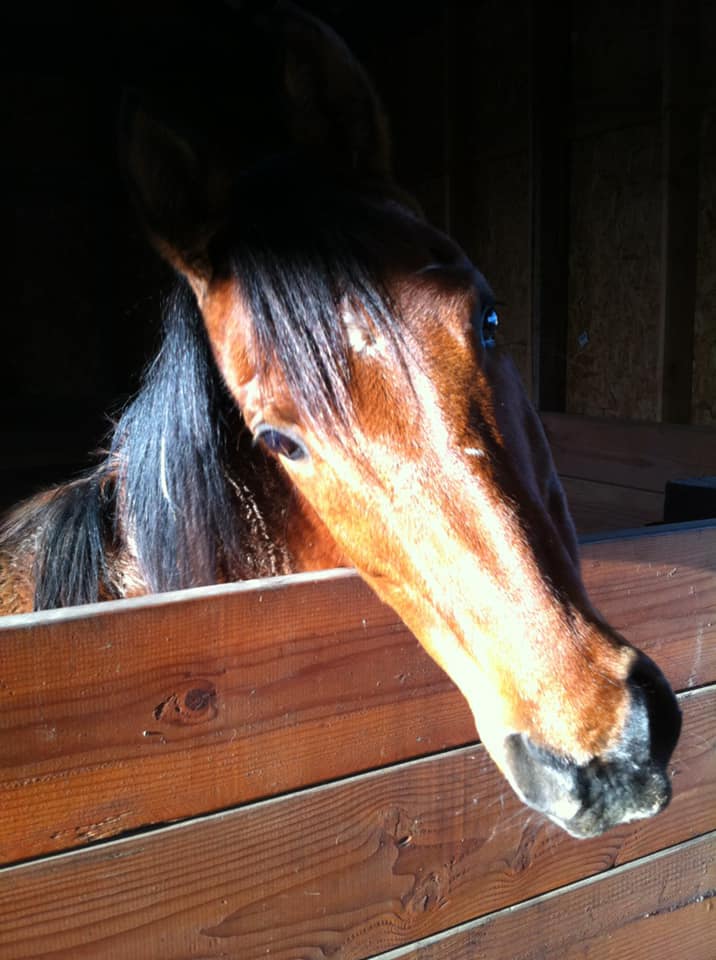
After our drivey-drive, we got the barbecue going and had a nice supper with Draven of bratwurst and roasted potatoes. Kim and I went out to feed the horses after supper. Bob, our 32-year-old Arabian, got about halfway through his grain and then stopped to roll (this is not typical behavior for him).
Repeated getting up and down and rolling is a sign of colic in horses, so my antennae went up right away. He lost interest in the rest of his grain, and dropped and rolled three more times in the space of about five minutes. I called the vet, and a few minutes later had confirmation that Dr. Tom Keck was on his way and would be there as soon as possible.
Kim, Draven, and I spent the next 90 minutes or so doing everything we could to keep Bob up as he grew increasingly distressed. Despite our best efforts, he was dropping every few minutes and getting more and more reluctant to get back up. He eventually offered us a little trot, and we decided to try that.
Bob (typical Arabian) made it clear he could trot all night, and it seemed to offer him some relief, so Draven and I tag-teamed as handlers, passing the lead line off like a baton in a relay race so the other could rest for a few minutes. We managed to keep Bob up for the remaining 15-20 minutes, but we were both just about done in when Dr. Keck arrived.
As soon as we stopped for Dr. Keck to examine him, Bob went down again. Dr. Keck was able to quickly diagnose a probable massive rupture of the chordae tendineae in his heart, which resulted in a blood clot that cut off the blood supply to his gut. It was an easy decision: Bob was euthanized within a few minutes.
No matter how much we try to dress it up, there is no dignity in death for anyone. For horses and other livestock, the grief of personal attachment and loss is compounded by the practical issue of dealing with several hundred pounds (or more) of dead animal—often in a location that was chosen for humane reasons rather than practical ones. So, I am really grateful that my last memories of Bob are predominantly from those 15-20 minutes that Draven and I had him trotting around.
The moon was nearly full, washing everything with light. If you haven’t spent time outside with nothing but moonlight for illumination, you’re missing out on one of life’s bits of magic. The quality of bright moonlight changes shapes and textures, hiding some things and revealing others. It is strong enough to cast shadows, but soft enough that the world is largely viewed in silhouette.
In this case, that particular light transformed Bob from a swaybacked, skinny old horse in distress to a young, perky Arabian again. His distress diminished and he acted like he was trotting around the show ring in a halter class: attentive to his handler, matching him stride for stride, ears up and forward, tail set high, and light on his feet. An unexpected gift of the moonlight….
I hope your week goes well for you, wherever you find yourself.
-Mike
Beautiful post, Mike.
Thanks, Mary!