
Dear friends,
As I mentioned in my previous letter, Draven and I have been mowing a fair bit lately. For us, that means mowing with a scythe.

jokes—it’s okay, we’re used to it.
With a scythe, we can easily mow under the bottom wire of a fence and around fence posts and trees. We can selectively mow to encourage the growth of some plants and remove others. Even with a grass blade mounted on the snath, our scythes can handle the odd bit of light brush up to 1/4″ in diameter; if the brush is heavier or thicker, we can quickly switch to a heavy brush blade and take out brush up to 1/2″ in diameter. (A scythe is an especially fine tool for controlling Himalayan and cut-leaf blackberry, by the way!)
Compared to a weed whacker, a scythe doesn’t take a whole lot longer, provides us with healthy exercise, and is quiet. Instead of plant material scattered 12 feet in every direction, whatever you’re mowing ends up in tidy windrows that are easy to deal with and look pleasing. Instead of smelling gasoline exhaust, you smell the plants that you’re mowing: the subtle smells of the various grasses mixed in with the scents of the occasional herbaceous plants (like wild rose and mint). Instead of getting numb hands from vibration and sweating inside protective gear, you get an aerobic full-body workout while wearing regular work clothing.
Aside from weed control, we also use our scythes in the late spring and early summer to make hay out of various small areas around the farm, such as the fescue and orchard grass that makes up the back yard of the farmhouse. It adds up to a couple of tons of loose hay each spring, and the horses will leave their grain pans to eat this hay, making it even more worthwhile.
Is there some romanticism at work here in our use of scythes for mowing? Sure! Just four generations ago (my 2nd-great-grandparents on my dad’s side), my ancestors were harvesting their wheat, oats, and barley and making hay using using scythes. In fact, just about anyone living on a farm even 100 years ago would have known how to use this tool that nowadays virtually no one in the United States has ever seen outside of a museum or an antique store. (Points for learning an obscure skill? Achievement unlocked!)
But there is also a healthy dose of pragmatism. The European-style scythes that we use are the result of hundreds of years of refinement that have yielded a light-weight, versatile tool ideally suited for its task. Although a scythe is relatively expensive for a hand tool (around $200 for a good quality snath and blade), it’s a one-time investment that will require minimal expense to maintain for many years. As long as it’s clean and oiled when you put it away, it will be ready for immediate use the next time you pick it up.
In terms of scale (something that we think about a lot here), a scythe forces you to maintain a human-scale perspective. A $200 tool cannot put you into debt that will take decades to pay off. A person skilled with a scythe can only mow an acre a day, so it removes any temptation to bite off more than you can chew. Each stroke of the scythe only cuts a few inches of grass, so you become intimately familiar with the field—and you definitely take care not to waste what you mowed!
Lastly, there is the mindfulness aspect of mowing with a scythe. Mowing with a razor-sharp piece of steel that is 2-3 feet long demands your attention; aside from safety, the scythe will not cut efficiently if used carelessly, resulting in rapid fatigue and misery. At the same time that mowing demands your attention, it also allows the less-conscious parts of your mind are free to wordlessly roam and ruminate in the background.
Your body begins to generate “feel good” biochemicals, and you find yourself in a state of flow (as first described by psychologist Milhaly Csikszentmihalyi). You are keenly aware of the species and condition of the grass you are mowing, the distinctive sound of the blade taking a good stroke, your breathing, the feel of the scythe in your hands, the smell of the grass, the way the sunlight glistens off drops of dew, the tiny changes in terrain, the occasional rustling of small animals in the grass, the slow shuffle of your feet in time with your strokes, and the sound, sight, and feel of the breeze soughing across the field.
If you’re mowing with others en echelon, an unspoken rhythm—a groove—may establish itself. As you gain experience, you will find that have just enough breath to engage in occasional bits of conversation. You will share the quiet satisfaction of pausing with your comrades in arms to sharpen your blades and admire the neat windrows behind you. You will take a rest together in the shade of a tree, sharing some switchel or shrub (or a modern equivalent like Gatorade) as refreshment. You will pause from time to time to silently observe a red-tail hawk hunting just fifty feet away or to hear the rustling feathers of a pair of ravens cavorting overhead.
If this meditation upon the mysteries of mowing has motivated you, drop me a line so we can set up a mowing lesson. With mowing, it really is a case of the more the merrier.
The temperature is only in the mid 70s today and there is a good southerly breeze keeping things cool. This morning, Draven finished putting in anti-gopher mesh on one of our raised beds in the kitchen garden (which required taking all the soil out of it yesterday). He hauled composted manure up to mix in, too. I helped him refill the bed the with topsoil, but he did the bulk of the work. Then he left for well-deserved long weekend that he is spending doing some socially distanced camping with his girlfriend and family.
Just as Draven and Claire were leaving, I sold a ton of our organic hay to a returning customer from last year. This fellow is the owner of Stirs the Soul, an artisanal chocolatier just a few miles away from us. (And he brought samples! That’s my kind of customer!)
The chocolate served as a balm to my unfortunate discovery that European paper wasps (Polistes dominula) will occasionally build nests in hay bales. I was only stung once, fortunately, but the wasps got to keep the bale.
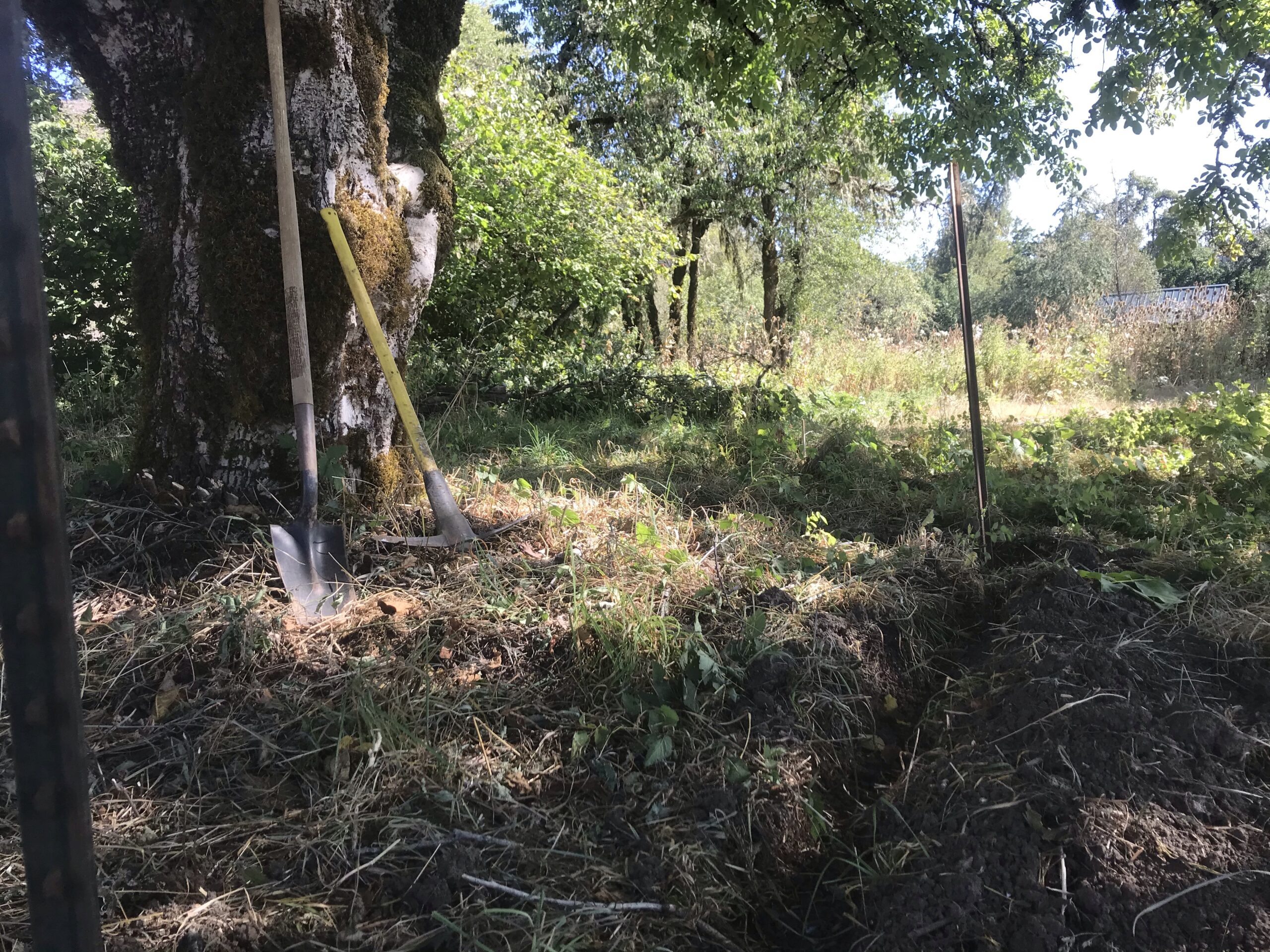
With the hay sale completed, I’m taking advantage of the cooler weather today (it’s supposed to be in the upper 80s and 90s again for the next several days) to work on our anti-squirrel barrier around our two 100+ year-old English walnut trees. Unfortunately, our Walnut Protection Project involves a mattock and a trenching shovel rather than the much-more-refined scythe.
I took a break to finish up this letter, but now I’ve run out of excuses to avoid literal “pick-and-shovel work” any longer. So, stay safe, and be sure to take a moment to remember the struggles of Americans to guarantee safe and fair working conditions this Labor Day weekend.
-Mike